
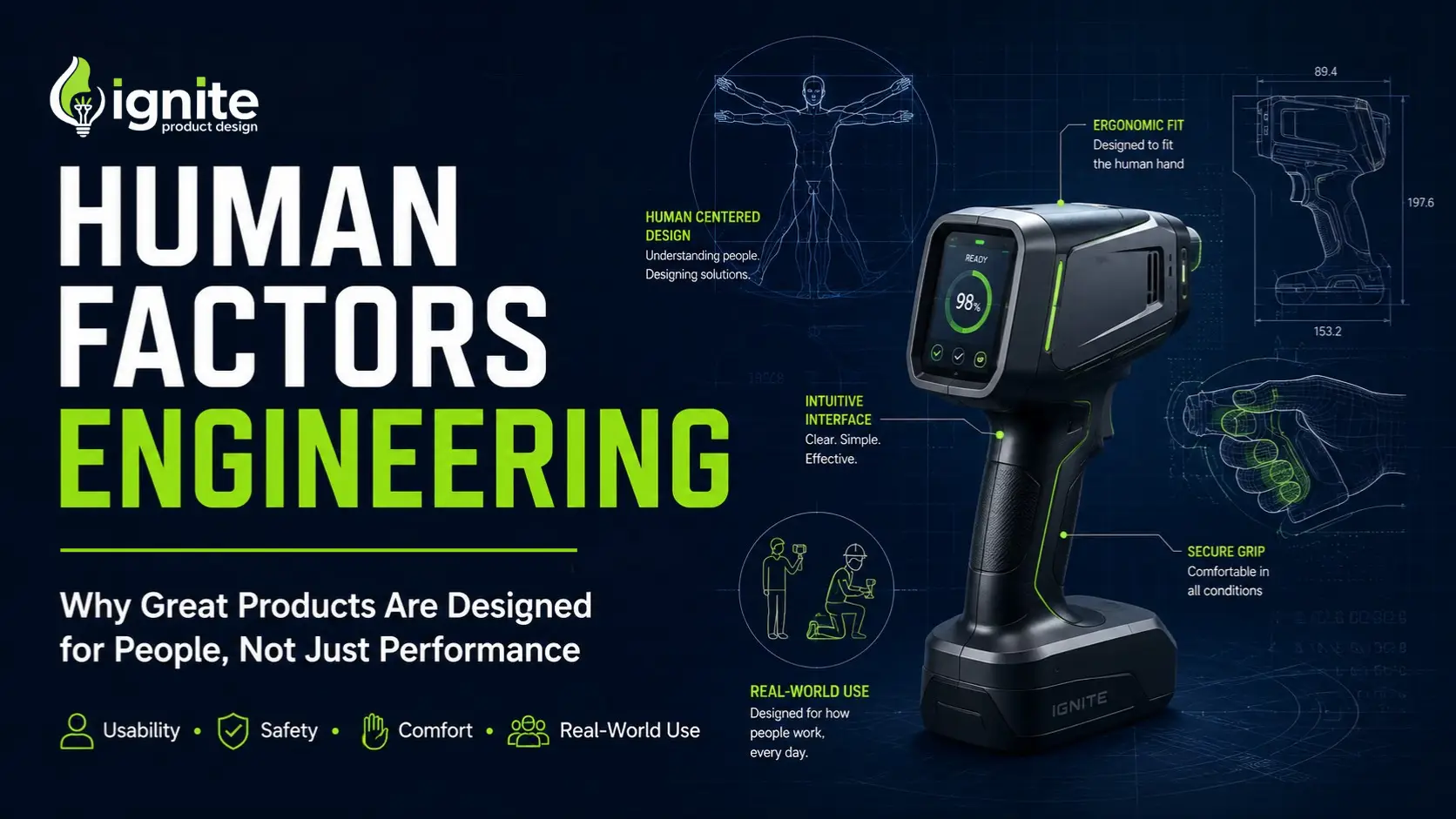
A product can be technically sound, visually appealing, and manufactured to high standards—but still fail in the hands of the people who use it.
Why?
Because successful products are not designed for drawings, CAD models, or engineering specifications. They are designed for real people operating in real environments.
This is where human factors engineering becomes essential.
By understanding how people interact with a product, designers and engineers can identify potential problems early, improve usability, and reduce costly redesigns later in development.
At Ignite Product Design, we help inventors, startups, and companies look beyond how a product works on paper and evaluate how it performs in the real world.
Human factors engineering is the practice of designing products around the capabilities, limitations, and behaviors of the people who will use them.
The goal is to create products that are not only functional but also intuitive, safe, and enjoyable to use.
Many product problems are not caused by engineering failures.
They are caused by the way people interact with the product.
A design may work perfectly in a controlled environment but become frustrating, confusing, or even unsafe when used by real customers.
Considering human factors early helps identify these issues before they become expensive to correct.
The earlier these considerations are made, the greater the opportunity to improve the final product.
Can users quickly understand how to operate the product?
Even small ergonomic improvements can make a significant difference in long-term usability.
Products should help prevent misuse whenever possible.
Many expensive product changes occur late in development because usability issues were discovered too late.
Identifying these problems during the design process is significantly less expensive than correcting them after tooling, production, or product launch.
Good human factors engineering helps reduce technical, financial, and customer satisfaction risks.
Customers rarely judge a product solely by its technical specifications.
They remember how easy it was to use.
They remember whether it solved their problem.
They remember whether it felt intuitive, comfortable, and reliable.
Products that prioritize the user experience are often more successful because they encourage adoption, reduce frustration, and build trust.
Engineering excellence and user-centered design work best when they support each other.
At Ignite Product Design, we believe successful products are built by combining engineering expertise with an understanding of real user needs.
By considering these factors early, we help clients reduce development risk and create products that perform well both technically and practically.
A product can meet every engineering specification and still fall short if it does not work well for the people who use it.
Human factors engineering helps bridge the gap between technical performance and real-world usability.
When engineering decisions are guided by the needs of actual users, products become easier to use, safer to operate, and more successful in the marketplace.
Because the best products are not only engineered to work.
They are engineered for people.
Whether you’re developing a new invention or improving an existing product, considering human factors early can help reduce costly changes later.