
Product Insights

Concept Research: Why Product Development Should Begin Before CAD and Prototyping

Learn why concept research should happen before CAD, prototyping, and manufacturing. Evaluate function, feasibility, usability, cost, materials, assembly, and production risks early.

Building too quickly can create expensive problems later.

When inventors, startups, and companies are excited about a new product idea, the natural instinct is often to move directly into CAD development, prototyping, or manufacturing.

Seeing a digital model or physical prototype can make the project feel real. However, beginning detailed development before the concept has been properly evaluated can lead to wasted time, unnecessary redesigns, and costly engineering problems.

Before a product moves forward, the concept should be reviewed carefully.

This early stage is known as concept research.

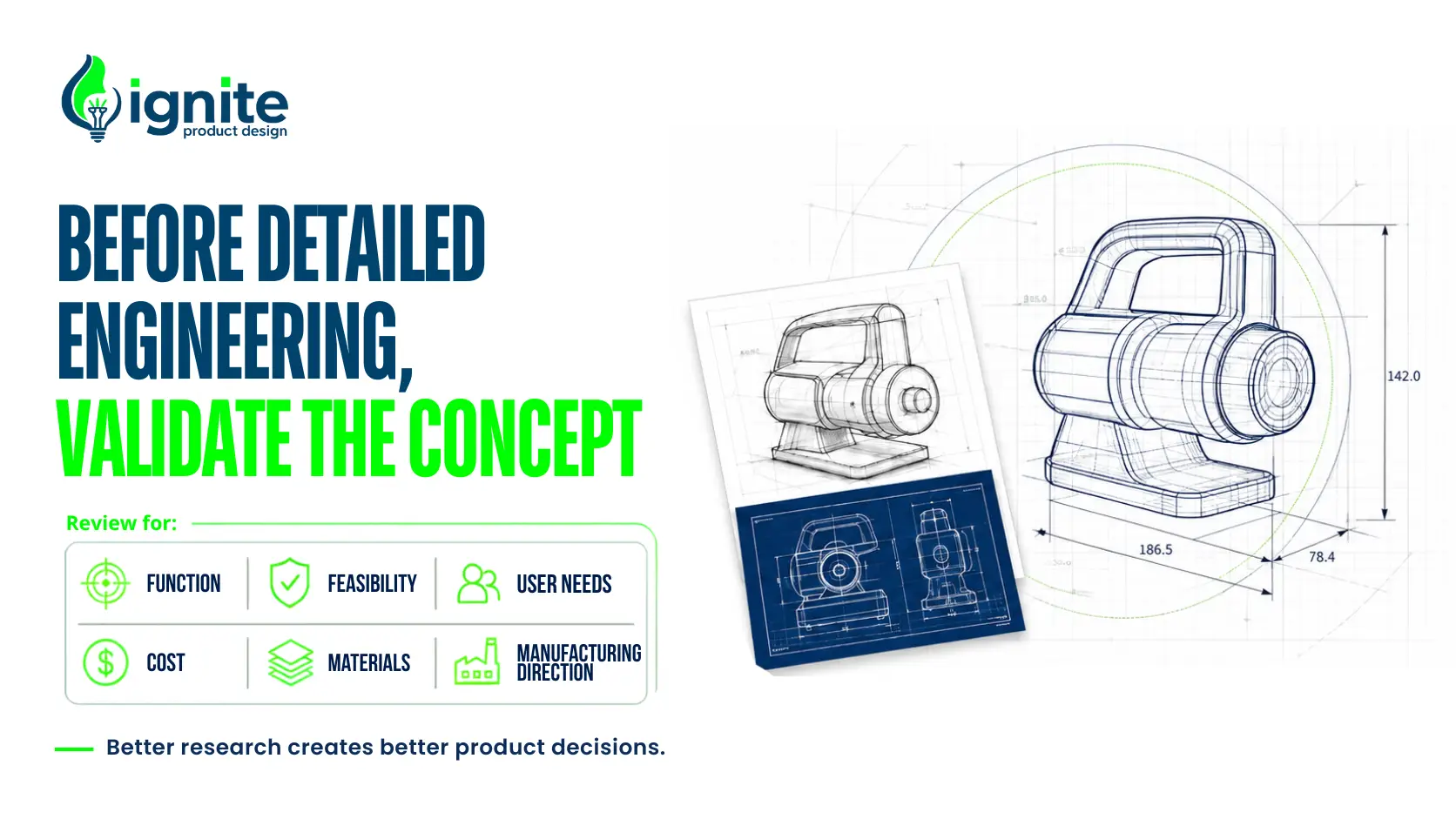
Concept research helps teams understand whether a product idea is functional, feasible, usable, cost-aware, and realistic for manufacturing before major development investments are made.

At Ignite Product Design, Concept Research is the first phase of our product development process because better decisions at the beginning can create a clearer path from idea to engineered product.

What Is Concept Research?

Concept research is the process of examining a product idea before detailed engineering begins.
 
The goal is not to complete the design.

Instead, the goal is to understand the opportunity, identify major risks, clarify requirements, and determine the most practical next step.

Concept research may involve reviewing:

This work creates a stronger foundation for the engineering phases that follow.

Why Moving Directly Into CAD Can Be Risky

CAD is an important product development tool, but it should not be treated as the first answer to every product idea.
 
A detailed CAD model can represent a concept visually without proving that the product is technically practical, economically realistic, or suitable for the intended user.

When teams move into CAD too soon, they may spend significant time refining a direction that has not been properly evaluated.

This can lead to:

CAD becomes far more valuable when it is built on clear requirements and informed engineering decisions.

Feasibility: Can the Concept Work?

A product may sound promising while still presenting significant engineering challenges.

 
Feasibility evaluation looks at whether the concept can realistically work within technical, physical, and financial constraints. 

This may involve questions such as:

The purpose of feasibility review is not to discourage ambitious ideas.
 

It is to identify where additional research, testing, or alternative solutions may be needed.

Usability: Will the Product Work for Real People?

Technical function alone does not guarantee product success.


A product must also be understandable, comfortable, safe, and practical for the people who will use it.

Concept research should consider:

Considering usability early can prevent a technically functional product from becoming frustrating or unsafe in real-world use.

Cost: Is the Product Economically Realistic?

A product can be technically possible and still be commercially unrealistic.


Early cost evaluation helps determine whether the concept has a reasonable business path.

Important considerations include:

Cost should not be treated as something to consider only after the design is complete.
 
Many of the decisions made during concept development directly influence the eventual cost of production.

Materials: What Should the Product Be Made From?

Material selection affects strength, appearance, weight, durability, cost, and manufacturability.

During concept research, engineers may begin evaluating whether the product should use:

The final material may not be selected during this early phase, but potential options should be reviewed.
 
A material that performs well technically may be too expensive, difficult to manufacture, or unsuitable for the intended environment.
 
The best material is usually the one that provides the right balance of performance, cost, availability, and manufacturing practicality.

Assembly: How Will the Product Fit Together?

Assembly is often overlooked during early product planning.
 
However, the way a product is assembled can significantly affect its cost, reliability, maintenance requirements, and production speed.

Concept research may examine:

Simplifying the product architecture early can reduce both engineering complexity and long-term production costs.

Manufacturing Direction: How Could the Product Be Produced?

A working prototype is not necessarily a manufacturable product.
 
Prototype methods are often designed to produce a small number of parts quickly. Production methods must create consistent parts at an acceptable cost and volume.

During concept research, teams should begin considering:

Understanding the likely manufacturing direction helps prevent the design from developing in a way that is difficult or expensive to produce.

Concept Research Helps Identify Risk Early

Problems are usually easier and less expensive to solve before detailed engineering begins.

For example, changing a concept during an early discussion may require only a few hours of research.
 
Changing the same concept after detailed CAD, prototyping, and tooling may require weeks of redesign and substantial additional expense.

Concept research can uncover risks involving:

Not every risk can be eliminated, but understanding the risks allows teams to make more informed decisions.

Better Research Supports Better Engineering

Concept research is not separate from engineering.

It prepares the project for engineering.
 
A well-researched concept gives engineers clearer goals, stronger requirements, and a more realistic design direction.

This can help:

Instead of asking engineers to begin with an incomplete idea, concept research gives them a more informed foundation on which to build.

Concept Research at Ignite Product Design

At Ignite Product Design, Concept Research is Phase 0 of our product development process.
 
During this phase, we help inventors, startups, and companies examine their product ideas through a practical engineering lens.

Depending on the project, we may review:

The objective is not to promise that every idea is ready for development.
 
The objective is to provide greater clarity before significant engineering decisions are made.

A Stronger Path From Idea to Product

Successful product development is not about moving as quickly as possible.

It is about moving forward with enough information to make good decisions.

Skipping concept research may appear to save time at the beginning, but unresolved questions often return later as engineering changes, prototype failures, production problems, and additional costs.

By evaluating function, feasibility, usability, cost, materials, assembly, and manufacturing direction early, teams can approach detailed engineering with greater confidence.

Better products begin with better questions.
 
And better decisions early can create a stronger path from idea to production.

Is Your Product Idea Ready for Engineering?

Before investing heavily in CAD, prototyping, tooling, or manufacturing, take the time to evaluate the concept.