
A great idea is an exciting place to start.
But having a strong product idea does not automatically mean it is ready for engineering, prototyping, or manufacturing.
One of the most common mistakes in product development is moving too quickly from an idea to building something tangible. The excitement of creating a new product often leads inventors and companies to jump directly into CAD models or prototypes before fully understanding whether the concept can realistically succeed.
The result can be expensive redesigns, technical challenges, or products that never make it to production.
Before engineering begins, every product idea should be carefully evaluated.
Asking the right questions early can save significant time, money, and frustration later.
The earliest decisions in product development often have the biggest impact on cost, schedule, and product success.
A concept that seems simple on paper may present unexpected challenges when real-world constraints are considered.
Taking the time to answer these questions helps create a clearer and more confident path forward.
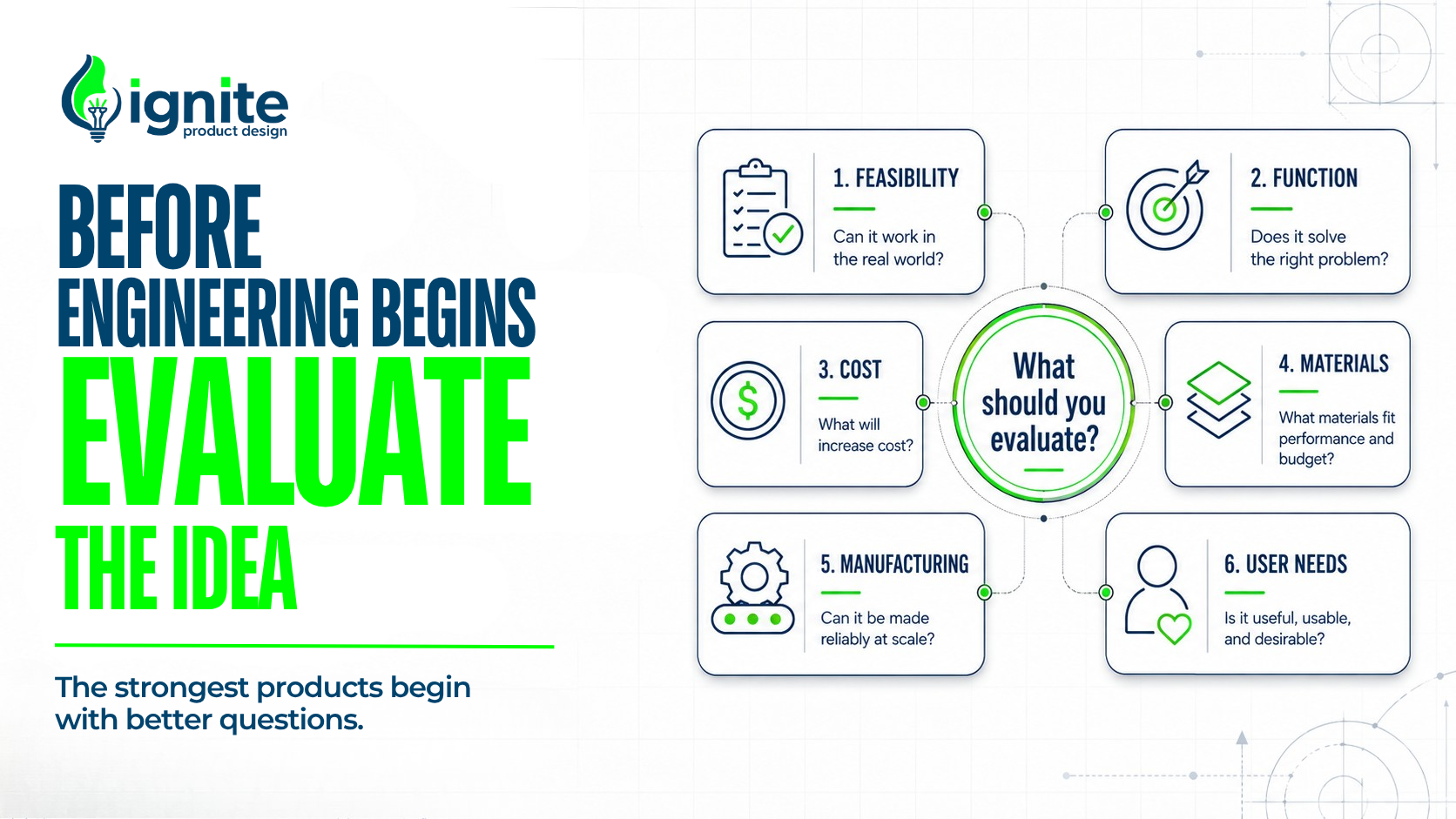
Feasibility is often the first and most important question.
A product idea may sound compelling, but it still needs to obey the laws of physics, materials, manufacturing limitations, and cost realities.
The goal is not to eliminate ambitious ideas.
The goal is to understand what challenges exist and determine whether they can be solved.
Identifying risks early is significantly less expensive than discovering them after major engineering work has already been completed.
A product must do more than simply exist.
It must perform the task it was created to accomplish.
In many cases, simplifying functionality early leads to a more reliable and easier-to-manufacture product.
The best products often do fewer things exceptionally well rather than attempting to do everything.
A technically impressive product can still fail if the economics do not make sense.
Cost considerations should begin long before manufacturing.
Even small design decisions can dramatically influence future production costs.
Understanding the financial realities early helps avoid pursuing concepts that may never become commercially viable.
Material selection affects nearly every aspect of a product.
The right material is not always the most advanced option.
Often, it is the material that best balances performance, manufacturability, and cost.
A product that works as a prototype may still be difficult or expensive to manufacture.
Manufacturing considerations should begin early because they often influence the design itself.
Considering manufacturing early often prevents major redesigns later in the development process.
This is why Design for Manufacturing principles are most effective when applied from the beginning.
Products succeed because they create value for users.
Even technically excellent products can fail if they do not address real customer needs.
Products designed around genuine user needs are more likely to gain adoption and succeed in the marketplace.
Successful product development is not about moving as quickly as possible.
It is about making informed decisions at the right time.
Before engineering begins, the most valuable activity may simply be asking better questions.
The answers to these questions often determine whether a product moves smoothly toward production or encounters expensive obstacles along the way.
Every product begins with an idea.
But successful products are built on a foundation of careful evaluation and informed decision-making.
At Ignite Product Design, we help inventors, startups, and companies evaluate product concepts through a practical engineering lens.
We look at technical feasibility, user needs, manufacturing considerations, materials, and the smartest next steps before significant development investments are made.
Because better decisions early create a clearer path from idea to production.
Before investing in CAD, prototyping, or manufacturing,
start by evaluating the idea.