
It’s understandable. The excitement of seeing a product come to life can create pressure to move fast.
However, one of the most common reasons products fail is because critical development steps were skipped in the rush to build something tangible.
Successful product development is not simply about creating a prototype. It is about making informed decisions at each stage of development so that the final product can be manufactured, scaled, and sold successfully.
That is why experienced product development teams rely on a structured process.
At Ignite Product Design, we guide clients through a phased approach that helps reduce uncertainty, manage risk, and improve outcomes throughout the development journey.
Every product begins as an idea.
The challenge is transforming that idea into a manufacturable product that performs reliably, meets customer needs, and can be produced profitably.
A phased product development process helps identify potential issues early, when they are less expensive and easier to solve.
Each phase builds upon the previous one, creating a stronger foundation for the next stage of development.
Every successful product starts with understanding the problem being solved.
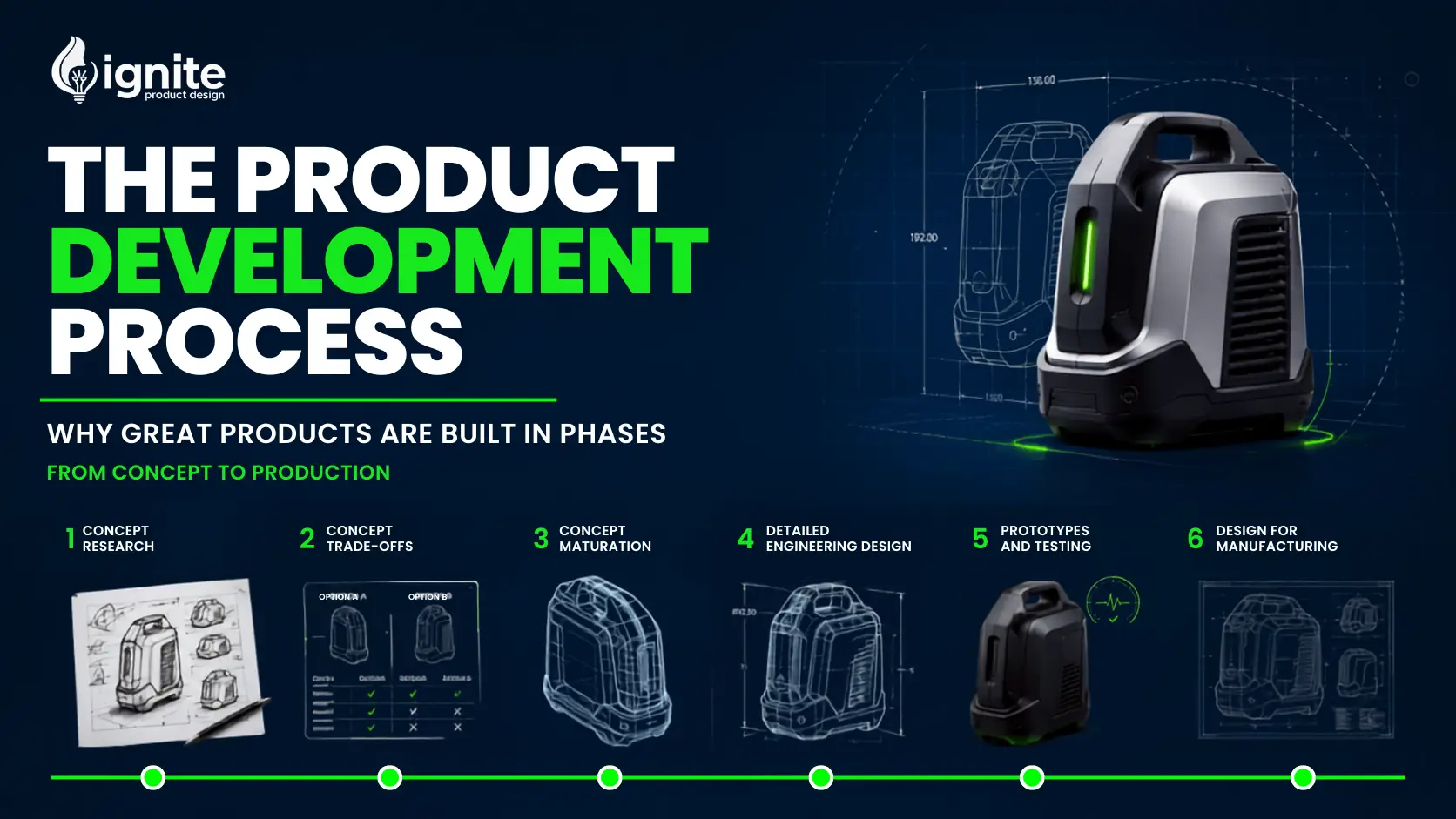
Concept Research focuses on evaluating the opportunity before significant engineering resources are invested.
The goal is to determine whether the idea has a realistic path forward and to establish the foundation for future development decisions.
Skipping this phase often leads to pursuing solutions that may not be technically feasible or commercially viable.
Once an opportunity has been identified, multiple solution approaches are evaluated.
There is rarely only one way to solve a problem.
Concept Trade-Offs allow teams to compare alternatives before committing to a specific direction.
This stage helps prevent costly design changes later by ensuring the selected concept aligns with project goals and constraints.
After a preferred concept is selected, the design begins to mature.
This phase focuses on refining the concept and addressing technical questions before detailed engineering begins.
Concept Maturation transforms a promising idea into a more complete and validated product direction.
By the end of this phase, there is significantly greater confidence in the product’s feasibility and development path.
Detailed Engineering Design is where concepts become real products.
Engineers develop the technical information required to manufacture, assemble, and validate the product.
This phase establishes the foundation for prototyping and production.
Well-executed engineering reduces risk, improves reliability, and helps avoid manufacturing issues later in the process.
A product may look perfect on a computer screen, but real-world testing often reveals important insights.
Testing helps identify design improvements before production investments are made.
Many successful products go through multiple prototype iterations before reaching a production-ready design.
This phase provides valuable feedback that improves both product quality and customer experience.
A working prototype does not automatically mean a product is ready for production.
Design for Manufacturing focuses on preparing the product for efficient, repeatable, and cost-effective manufacturing.
The objective is to ensure the product can be produced consistently while maintaining quality and controlling costs.
This phase bridges the gap between engineering and production.
Following a structured process offers several important advantages:
Reduced Risk
Potential issues are identified earlier, when they are less expensive to fix.
Better Decision-Making
Each phase provides information that supports smarter technical and business decisions.
Lower Development Costs
Avoiding major redesigns later in the project helps control overall costs.
Faster Path to Production
Although the process may appear slower initially, it often reduces delays caused by unexpected problems.
Improved Product Quality
Products developed through a structured process are generally more reliable, manufacturable, and user-friendly.
Product development is not a single event.
It is a series of informed decisions that gradually transform an idea into a successful product.
By moving through Concept Research, Concept Trade-Offs, Concept Maturation, Detailed Engineering Design, Prototypes and Testing, and Design for Manufacturing, companies can reduce uncertainty and improve their chances of success.
The most successful products are not necessarily developed the fastest.
They are developed through a process that minimizes risk and maximizes confidence at every stage.
Whether you’re an inventor with a new idea or a company developing the next generation of products, a structured development process can help turn uncertainty into a clear path forward.
Contact Ignite Product Design to discuss your project and learn how our phased product development process can help bring your product from concept to production.
A great design should not only work. It should be safe, intuitive, and practical for the people using it.